Security Film on Laminated Glass – Does It Actually Make Sense?
If you’re even asking this question, you’re already ahead of most buyers.
Laminated glass isn’t a cheap upgrade. It’s specified deliberately. So when someone suggests adding security film on top, the reaction is usually one of two things:
“Isn’t that overkill?”
or
“Is that just double insurance?”
The honest answer is: sometimes yes. Sometimes no. And the difference matters.
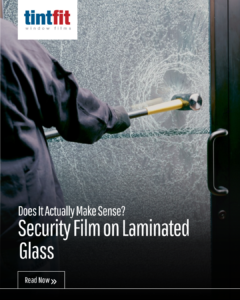
What Laminated Glass Really Does
Laminated glass has a bonded interlayer that holds shards in place when the pane breaks. It improves safety, reduces shattering and, in many cases, meets building regulations where impact protection is required.
It’s a strong foundation.
But laminated glass is primarily about containment after breakage. It is not automatically a high-security solution. The interlayer can stretch, tear and eventually give way under sustained force. That’s not a flaw, it’s just physics.
What Security Film Changes
Security film works differently. Applied to the internal face of the glass, it bonds across the full surface area and alters how the glazing behaves under impact.
Where laminated glass holds fragments together, security film increases tensile strength and resistance to penetration once the glass has already cracked.
- It doesn’t stop the glass breaking. Nothing truly does.
- It changes what happens next.
And that “what happens next” is often the crucial part in forced-entry scenarios.
Is It Just Double Protection?
In some environments, yes, and that’s exactly the point.
- Ground-floor commercial glazing.
- High-value retail.
- Healthcare facilities.
- Schools.
- Certain residential properties with public exposure.
In these cases, adding security film to laminated glass isn’t paranoia. It’s layered risk management.
Not because laminated glass is inadequate. But because layered systems behave differently under stress.
Security isn’t binary. It’s cumulative.
When It Doesn’t Make Sense
There are also plenty of scenarios where applying security film over laminated glazing may offer limited practical benefit.
- Upper floors with no public access.
- Low-risk residential elevations.
- Locations with minimal exposure or controlled entry.
If there is an absence of a credible attack risk profile, no history of forced entry in the area, and no specific security brief requiring enhanced delay performance, laminated glass alone may already exceed the realistic threat level.
In these situations, additional film may not represent a proportionate response to the actual risk.
Good specification is not about adding layers for the sake of it – it’s about aligning protection levels with real-world exposure, threat probability, and the performance objective of the glazing.
A Smarter Way to Think About It
For a thinking buyer, the decision isn’t about fear – it’s about behaviour.
- How will this pane respond under impact?
- How long does it hold?
- How does it fail?
Security film on laminated glass can absolutely make sense. But only when the performance objective justifies the layering.
And that’s the difference between specification and assumption.
If you’re weighing up the right approach for your glazing, we’re always happy to talk it through properly. And if you’re looking to purchase professional-grade security window films at competitive UK prices, you can order directly from our online shop at Tintfit Window Films.